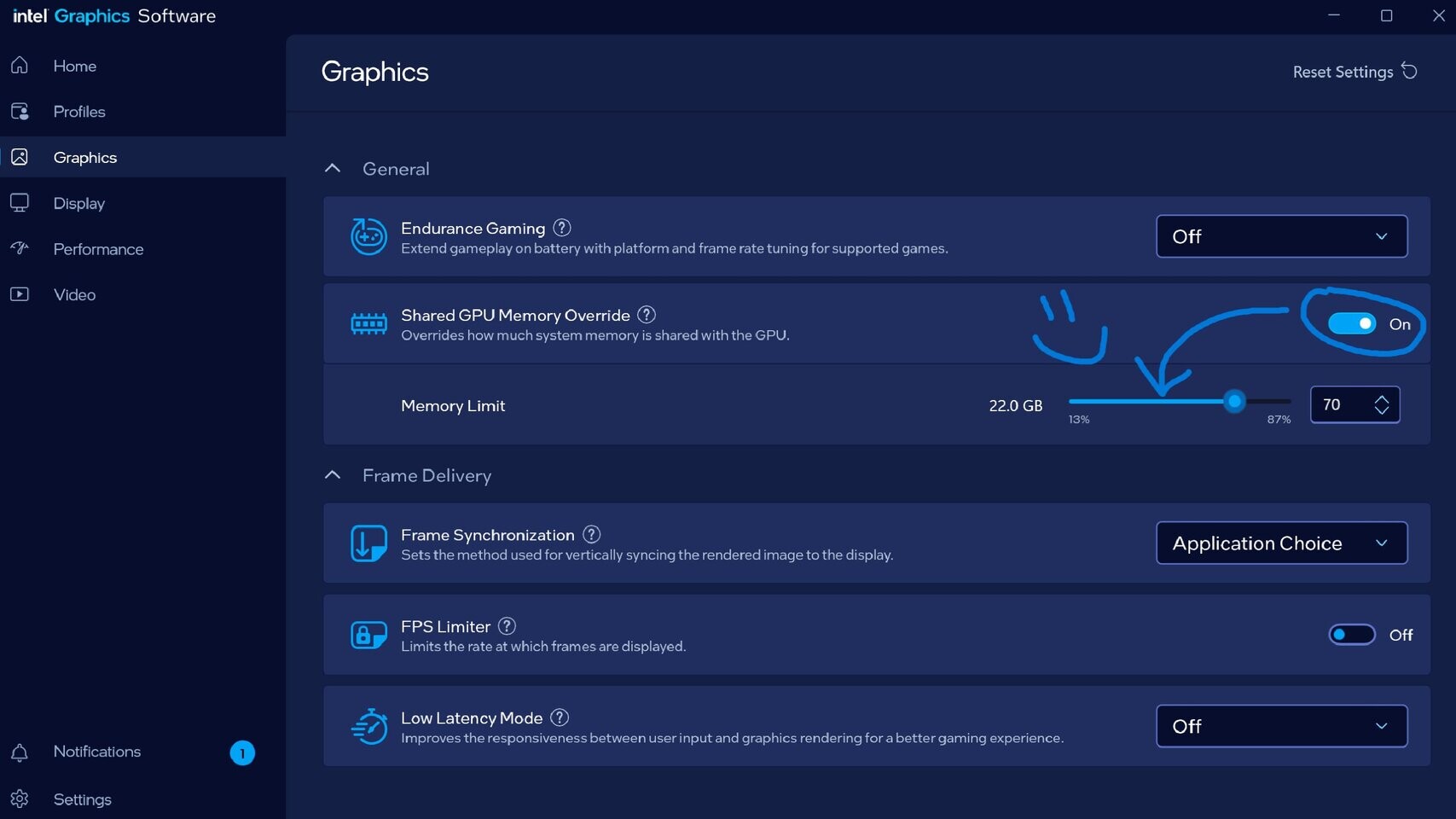
Intel has recently unveiled a new driver feature known as Shared GPU Memory Override. This feature is designed for integrated Arc GPUs found in specific Core Ultra systems, allowing them to reserve a larger portion of system RAM for video memory. Within the Intel Graphics Software, users will find a slider that can be adjusted to increase the percentage of system memory allocated to the iGPU. Initial reports suggest that the default setting is around 57%, but examples from vendors indicate that this control can potentially allocate up to 87% on high-memory laptops, as demonstrated by Intel.
Intel promotes this capability as a means to bridge the gap between integrated and discrete graphics solutions for memory-intensive tasks. This feature provides developers and power users with more flexibility for non-gaming activities, such as running local AI models.
Similar to AMD's Variable Graphics Memory feature for Ryzen AI platforms, Intel's implementation reallocates system RAM to the GPU to enhance performance. This approach leverages unified memory architectures to expand the effective VRAM pool. However, it is important to note that not all games will benefit from this reallocation, as some may load larger assets when more VRAM is available, potentially negating any performance gains.
To enable the Shared GPU Memory Override feature, users must install Intel's latest driver and reboot their system. Minimum RAM and platform requirements must also be met. OEMs may offer similar options in BIOS settings, and manufacturers will provide guidance on how to utilize this feature effectively.
For workloads that are consistently VRAM-limited, such as local LLMs, having the ability to increase the iGPU's memory capacity is crucial. This allows for the execution of larger models without relying on an internet connection.